Choosing between PA6 and PA66 is an important decision when manufacturing precision injection molded plastic parts. Both materials belong to the polyamide (nylon) family and offer good mechanical strength, wear resistance, and engineering performance. However, they do not behave in exactly the same way during molding or in service.
For manufacturers and product engineers, the difference between PA6 and PA66 can affect dimensional stability, moisture absorption, stiffness, impact resistance, heat resistance, mold shrinkage, and long-term component performance.
In general, PA6 is often selected when toughness, impact resistance, and a balance of performance and cost are important. PA66 is often preferred when a component requires higher stiffness, strength, and heat resistance. However, neither material is automatically better for every precision application. The correct choice depends on the part geometry, operating environment, required tolerances, and whether the material is reinforced with glass fiber or other additives.
This guide compares PA6 vs PA66 for precision injection molded parts, explains their key material differences, and provides practical selection advice for industrial components such as bushings, gears, rollers, bearings, and mechanical housings.
What Are PA6 and PA66 Nylon?
PA6 and PA66 are two widely used engineering thermoplastics known as polyamides, commonly referred to as nylon. Both materials contain repeating amide groups in their molecular structures, which contribute to their strength, toughness, and resistance to wear.
The main difference is their molecular structure. PA6 is produced from caprolactam, while PA66 is made from hexamethylenediamine and adipic acid. This structural difference affects their thermal behavior, mechanical properties, moisture response, and processing characteristics.
PA6 (Polyamide 6): PA6 is known for its good toughness, impact resistance, and balanced mechanical properties. It is commonly used in mechanical components, bushings, wear parts, and molded industrial products.
PA66 (Polyamide 66): PA66 generally offers higher stiffness, strength, and heat resistance than unreinforced PA6. It is often considered for structural components, automotive parts, electrical components, and mechanical applications exposed to higher operating temperatures.
Both materials are available in different grades, including unfilled nylon and glass-fiber-reinforced nylon. The properties of a reinforced PA6 or PA66 grade can differ significantly from those of its unfilled counterpart.
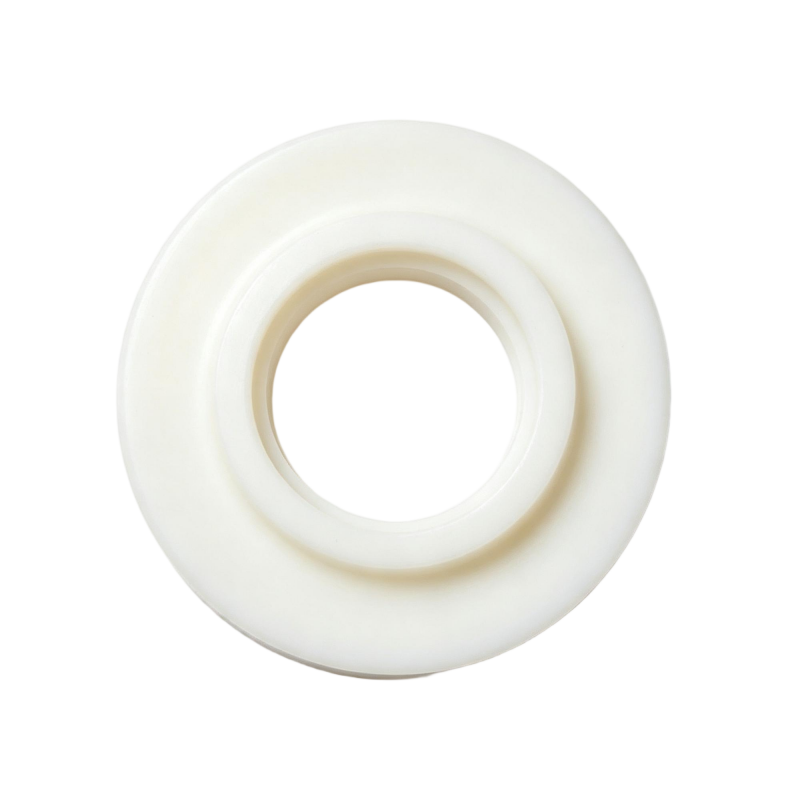
Yistar's published PA6 nylon step flange bushing is one example of an engineering plastic component manufactured through precision injection molding. The product uses PA6 nylon and features an integrated flange structure designed for axial positioning in machinery applications.
PA6 vs PA66: What Are the Main Differences?
Although PA6 and PA66 share many characteristics, their performance differences can influence material selection for precision molded components.
| Property | PA6 Nylon | PA66 Nylon |
|---|---|---|
| Tensile strength | Good | Generally higher |
| Stiffness | Good | Generally higher |
| Impact resistance | Often better toughness | Depends on grade and conditioning |
| Heat resistance | Good | Generally higher |
| Moisture absorption | Higher | Lower than PA6, but still hygroscopic |
| Dimensional stability | More affected by moisture changes | Generally better, but moisture-sensitive |
| Melting temperature | Lower | Higher |
| Typical applications | Bushings, wear parts, mechanical components | Structural parts, automotive and industrial components |
The table provides a general comparison of unfilled PA6 and PA66. Actual performance varies according to the resin manufacturer, grade, moisture condition, reinforcement content, and test method. For precision injection molding, engineers should always evaluate the specific material datasheet rather than relying only on general nylon properties.
Mechanical Strength and Stiffness: PA6 vs PA66
Mechanical strength is one of the first factors to consider when choosing nylon for precision molded parts. Components such as gears, bushings, bearing retainers, and structural brackets may experience continuous loads, friction, vibration, or repeated mechanical movement.
PA6 mechanical performance
PA6 provides a useful balance of strength, toughness, and impact resistance. It can absorb mechanical shock and is suitable for components that experience repeated movement or moderate impact loads.
For example, nylon bushings and sleeves may benefit from PA6's combination of toughness and wear performance. Its properties make it a practical option for many general industrial applications where extreme stiffness is not the primary requirement.
PA66 mechanical performance
PA66 generally provides higher tensile strength and stiffness than unfilled PA6. This can make it more suitable for parts that must maintain their shape under sustained loads or operate in mechanically demanding environments.
For structural brackets, load-bearing components, and certain automotive or industrial parts, PA66 may provide a useful performance advantage.
However, higher stiffness does not always mean better overall performance. A rigid component may be more vulnerable to impact damage in some designs, while a tougher material may better accommodate shock or deformation. The right choice depends on how the component is loaded during actual use.
Heat Resistance: When Is PA66 the Better Choice?
Operating temperature is another important consideration when selecting nylon for injection molded components.
PA66 generally has a higher melting temperature and better heat resistance than PA6. It is therefore often considered for components exposed to higher temperatures, especially when dimensional stability and mechanical strength must be maintained during operation.
PA6 can still perform well in many industrial applications, but its thermal performance should be checked against the actual operating conditions. Continuous service temperature, short-term temperature peaks, mechanical loading, and exposure time all influence material suitability.
For applications involving elevated temperatures, engineers should also consider heat deflection temperature and long-term thermal aging data from the specific resin grade. The melting temperature alone does not determine the maximum safe operating temperature of a finished part.
When to consider PA66:
- Components operate in relatively high-temperature environments.
- Parts must retain stiffness under sustained mechanical loads.
- Automotive or industrial components are exposed to heat from nearby equipment.
- Dimensional performance must be maintained under combined thermal and mechanical stress.
For reinforced grades, glass fiber can improve stiffness and heat-related mechanical performance. However, the final material choice must account for the effects of reinforcement on shrinkage, anisotropy, impact behavior, and mold design.
Moisture Absorption and Dimensional Stability in Precision Parts
Moisture absorption is one of the most important differences between PA6 and PA66, particularly for precision injection molded parts.
Both materials are hygroscopic, meaning they absorb moisture from the surrounding environment. As moisture enters the nylon structure, the material can expand and its mechanical properties can change.
PA6 generally absorbs more moisture than PA66. This means PA6 components may experience greater dimensional changes when moving between dry and humid conditions or when reaching moisture equilibrium during service.
PA66 usually offers better dimensional stability than PA6 in comparable unfilled grades, but it is not moisture-proof. Engineers should not assume that PA66 will maintain exactly the same dimensions regardless of environmental conditions.
For precision components, moisture-related changes can affect:
- Assembly clearance: Changes in component dimensions may affect how parts fit together.
- Hole and shaft dimensions: Moisture-related expansion can influence fitting accuracy.
- Gear engagement: Dimensional changes may affect tooth geometry and operating clearances.
- Sliding performance: Changes in size can influence friction and movement between mating parts.
- Long-term dimensional consistency: Components used in different humidity conditions may show different measurements over time.
When a plastic component has tight dimensional requirements, the inspection condition should be clearly defined. Measurements taken immediately after molding, after drying, and after moisture conditioning may not produce the same results.
For critical applications, specify the required conditioning method and acceptance criteria in the technical drawing or quality documentation. This helps the manufacturer and customer evaluate the part under comparable conditions.
PA6 vs PA66 for Injection Molding: Processing Considerations
Material selection does not end with mechanical properties. PA6 and PA66 also have different processing characteristics, which can affect mold design, production settings, part quality, and dimensional consistency.
Drying and moisture control
Both PA6 and PA66 must be properly dried before injection molding according to the resin manufacturer's processing recommendations. Moisture in the material can cause processing defects such as splay marks, bubbles, and surface imperfections. Excessive moisture can also contribute to molecular degradation during processing.
Drying conditions should be selected according to the exact resin grade, packaging condition, moisture level, and equipment. A generic drying temperature or time should not replace the resin supplier's technical datasheet.
Melt temperature and mold temperature
PA6 and PA66 have different melting and processing temperature requirements. PA66 generally requires a higher melt temperature than PA6. The correct processing window depends on the grade, reinforcement, machine, mold design, and part geometry.
Incorrect temperatures or unstable processing conditions can lead to incomplete filling, excessive shrinkage variation, warpage, or inconsistent mechanical performance.
Shrinkage and warpage
Both PA6 and PA66 are semi-crystalline materials, so shrinkage during cooling must be considered during mold design. Their shrinkage behavior can vary with material grade, wall thickness, gate location, mold temperature, flow direction, and reinforcement content.
Glass-fiber-reinforced nylon often has lower shrinkage in the fiber-flow direction than unfilled nylon, but it can also produce anisotropic shrinkage and warpage. This makes gate placement, cooling design, and mold-flow evaluation particularly important for precision parts.
For additional material-selection guidance, see Yistar's article on ABS vs PC vs PA vs POM engineering plastics.
PA6 vs PA66 vs Glass-Fiber-Reinforced Nylon
For demanding precision injection molded parts, engineers may need to compare unfilled nylon with glass-fiber-reinforced grades such as PA6-GF30 and PA66-GF30.
Glass fiber reinforcement changes the mechanical behavior of nylon by increasing stiffness and reducing deformation under load. It can also improve dimensional performance in certain applications, although the result depends on fiber orientation and moisture conditioning.
PA6-GF: Glass-fiber-reinforced PA6 combines the toughness of the PA6 base material with increased stiffness and strength. It can be considered for brackets, housings, supports, and mechanical components requiring improved rigidity.
PA66-GF: Glass-fiber-reinforced PA66 is often selected for structural applications requiring higher stiffness, strength, and heat resistance. It is commonly considered for demanding automotive and industrial components.
However, glass fiber is not automatically the best solution for every precision part. Reinforced nylon can be more abrasive to tooling, and fiber orientation can create differences in shrinkage and mechanical properties along different directions.
| Material | Main Characteristics | Potential Applications |
|---|---|---|
| PA6 | Balanced strength, toughness, impact resistance | Bushings, washers, wear components |
| PA66 | Higher stiffness, strength, and heat resistance | Structural and load-bearing components |
| PA6-GF | Improved stiffness and strength compared with unfilled PA6 | Brackets, supports, reinforced housings |
| PA66-GF | High stiffness and improved thermal-mechanical performance | Automotive and industrial structural parts |
The final choice should be based on the actual grade datasheet and application requirements. Glass-fiber content, fiber orientation, wall thickness, and molding conditions can all influence the finished component's performance.
Which Nylon Is Better for Precision Injection Molded Parts?
The best nylon depends on what the component needs to do. The following selection guide can help engineers narrow down the options.
Choose PA6 when:
- The component requires a good balance of strength and impact resistance.
- Toughness and resistance to mechanical shock are important.
- The part is used in general industrial machinery or equipment.
- Moisture-related dimensional changes can be accommodated in the design.
- The application does not require the higher stiffness or heat resistance of PA66.
Choose PA66 when:
- The part needs higher stiffness and tensile strength.
- Operating temperature is relatively high.
- Dimensional stability is important under comparable environmental conditions.
- The component experiences sustained mechanical loading.
- The design requires a reinforced engineering plastic grade for structural performance.
Consider glass-fiber-reinforced nylon when:
- The component needs additional rigidity.
- Deformation under load must be reduced.
- The part is used in structural or load-bearing applications.
- Thermal-mechanical performance is more important than maximum flexibility.
It is also worth considering whether nylon is the most suitable material at all. For some sliding or precision gear applications, POM may offer better dimensional stability and lower friction. For higher-temperature requirements, other engineering plastics may be more appropriate.
Material selection should therefore begin with the part's operating conditions rather than assuming that PA66 is always an upgrade from PA6.
Applications of PA6 and PA66 in Precision Plastic Components
PA6 and PA66 are used across many industries because they combine useful mechanical properties with the flexibility of injection molding.
Industrial machinery
Nylon is used in bushings, washers, bearing sleeves, rollers, gears, and other mechanical components. Depending on the load, temperature, and friction conditions, PA6 or PA66 may be selected to replace certain metal components.
Yistar's published industrial product range includes a PA6 step flange bushing, which uses an integrated flange structure for axial positioning. The product page also describes its lightweight, self-lubricating, and wear-resistant characteristics.
Automotive components
PA6 and PA66 can be considered for automotive brackets, clips, housings, connectors, and structural components. Reinforced grades may be useful when higher stiffness and heat resistance are required, subject to the specific vehicle application and material specifications.
Electrical and electronic components
Nylon can be used for selected connector housings, internal supports, cable management components, and other molded parts. Electrical performance, flame-retardant requirements, moisture exposure, and dimensional tolerances should be evaluated for each application.
Industrial automation and conveyor systems
Mechanical components such as guide elements, rollers, bearing retainers, and wear parts may use engineering plastics to reduce weight, noise, and maintenance requirements. The material should be matched to contact pressure, operating speed, temperature, and lubrication conditions.

Explore Yistar's custom plastic components for industrial machinery to learn more about its engineering plastic applications, including gears, bearing retainers, casters, seals, pump bodies, and guide rail sliders.
How to Select PA6 or PA66 for a Custom Injection Molding Project
Before confirming the material for a precision molded component, engineers should review several technical factors together. Choosing a resin based on one property alone can lead to problems during production or actual use.
Define the operating environment
Identify the continuous operating temperature, peak temperature, humidity, chemical exposure, and expected service life. These conditions help determine whether PA6, PA66, or a reinforced grade is more appropriate.
Understand the mechanical loading
Determine whether the component experiences impact, tension, compression, bending, friction, or repeated movement. A part that absorbs shock may require different material characteristics from a rigid support under continuous load.
Set dimensional and tolerance requirements
Identify critical dimensions and mating features. Consider moisture conditioning, shrinkage, warpage, and the inspection environment when defining tolerances.
Evaluate the part geometry
Wall thickness, ribs, bosses, holes, inserts, and gate locations can influence filling, cooling, shrinkage, and fiber orientation. A design review before tooling can help identify potential manufacturing issues.
Confirm the exact resin grade
PA6 and PA66 are broad material families rather than single, uniform specifications. Compare datasheets for the actual resin grade, including reinforcement content, moisture-conditioned properties, thermal performance, shrinkage, and processing recommendations.
Validate the molded sample
For critical components, test the sample under representative operating conditions. Check dimensions, assembly fit, mechanical performance, and environmental stability before approving mass production.
Custom PA6 and PA66 Injection Molding Solutions from Yistar
Choosing the right nylon grade is only one part of producing a reliable precision plastic component. Mold design, resin preparation, injection parameters, cooling, dimensional inspection, and post-processing also influence the final result.
Xiamen Yistar Precision Manufacturing Co., Ltd. specializes in plastic injection molding, mold development, product customization, and assembly. Its published engineering plastic product information lists Nylon (PA6/PA66), POM, HDPE, UHMWPE, ABS, and PEEK as material options for customized industrial components.
Yistar's engineering plastic product range includes gears, rollers, bearings, washers, bushings, and linear guides for industrial machinery, automation systems, and conveyor applications.
For customers developing nylon components, Yistar can assess the project based on technical drawings or samples, material requirements, production quantity, and surface treatment specifications. The company's published customization process includes technical drawing confirmation, sample production, mass production, product inspection, assembly, and packaging.
Whether you are developing a PA6 bushing, a PA66 structural component, or a custom engineering plastic part, the material and manufacturing process should be evaluated together to achieve the required performance and dimensional consistency.
To discuss your project, visit Yistar's Contact Us page and provide your drawings, material preference, expected quantity, and application requirements.
Frequently Asked Questions About PA6 vs PA66
What is the main difference between PA6 and PA66?
PA6 and PA66 are both nylon engineering plastics. PA6 is generally known for good toughness and impact resistance, while PA66 usually offers higher stiffness, strength, and heat resistance. PA6 also typically absorbs more moisture than PA66, which can affect dimensional stability.
Is PA66 stronger than PA6?
In general, unfilled PA66 has higher tensile strength and stiffness than unfilled PA6. However, actual performance depends on the specific resin grade, moisture condition, temperature, and reinforcement content.
Which is better for precision injection molded parts, PA6 or PA66?
PA66 is often considered when higher stiffness, strength, and dimensional stability are important. PA6 may be a better choice when toughness and impact resistance are priorities. The correct material depends on the component's operating conditions and tolerance requirements.
Does PA6 absorb more moisture than PA66?
Yes. PA6 generally has higher moisture absorption than PA66. Both materials are hygroscopic, so moisture conditioning should be considered when designing and inspecting precision nylon components.
Is PA66 more heat-resistant than PA6?
Generally, yes. PA66 has a higher melting temperature and usually provides better heat resistance than PA6. However, the maximum service temperature depends on the exact resin grade, mechanical loading, exposure time, and operating environment.
What is the difference between PA6-GF30 and PA66-GF30?
Both are nylon grades reinforced with approximately 30% glass fiber. PA6-GF30 combines the PA6 base material with increased stiffness and strength, while PA66-GF30 generally offers higher thermal-mechanical performance. Both require consideration of fiber orientation, shrinkage, and warpage during mold design.
Can PA6 and PA66 be used for injection molded bushings and gears?
Yes. Both materials can be considered for selected mechanical components such as bushings, gears, rollers, and bearing-related parts. The final choice depends on load, friction, temperature, moisture exposure, wear requirements, and dimensional tolerances.
Does Yistar offer PA6 and PA66 plastic components?
Yistar's published engineering plastic product information lists Nylon (PA6/PA66) among its material options for custom CNC-machined and injection-molded components. Its website also features a specific PA6 nylon step flange bushing manufactured through precision injection molding. Specific PA66 product requirements should be confirmed with Yistar.