In minimally invasive medical device development, every millimeter matters. The entire system's performance hinges on the quality of its medical device components and assemblies. Medical device manufacturers face increasing pressure to achieve miniaturization while maintaining flexibility, reliability, and seamless integration. These demands touch every part, from signal connectors to flexible tubing.
This growth signals rising expectations for device performance. Successful device development depends on understanding how components that enable minimally invasive medical devices handle the extreme conditions of keyhole surgery, endovascular surgery, and endoscopic surgery. Each invasive procedure demands precision. Each non-invasive alternative requires different engineering. Mastering these component-level choices determines your medical device's reliability and your manufacturing success.
Key Takeaways
- The performance of minimally invasive medical devices depends on the reliability and integration of their individual components.
- Component selection involves balancing miniaturization, flexibility, electrical performance, material compatibility, and sterilization resistance.
- Medical device manufacturers require customized components that meet application-specific requirements rather than standard off-the-shelf solutions.
- Reliable cable assemblies, tubing systems, and precision components play a critical role in maintaining device safety and performance.
- Partnering with an experienced medical component manufacturer helps accelerate development and ensure consistent production quality.
Electronics and Imaging Components in Minimally Invasive Medical Devices
Every signal traveling through a minimally invasive device must survive extreme conditions. Component selection plays a critical role in maintaining signal integrity and preventing performance degradation caused by noise and interference. This section examines the electronics and imaging building blocks that make minimally invasive surgery possible.
Signal and Energy Transmission Components
Reliable connectors are essential for maintaining signal integrity in minimally invasive medical devices. When selecting component suppliers, manufacturers should evaluate dimensional consistency, contact resistance, and impedance control.
Several factors determine whether your connectors perform reliably:
- Dimensional consistency drives contact force and engagement depth, which directly affect resistance stability.
- Low, stable contact resistance and impedance control minimize signal loss and prevent noise coupling.
- Swaging, a cold-forming process, delivers tight dimensional repeatability and structural continuity for high-speed data transmission.
- Custom contact pins reduce diameter and control engagement depth, preserving internal architecture without compromising electrical performance.
Micro-coaxial cables offer another solution. These small-diameter cables provide low insertion loss while maximizing power transmission efficiency. Their compact size supports smaller device designs while maintaining electrical performance. Hybrid cable assemblies integrate power, signal, and thermal management into one package, balancing low loss with flexibility.
Endoscopic Imaging and Connectivity Components
Modern endoscopic surgery depends on crystal-clear imaging. A 4K video cable must support at least 18 Gbps to handle 4K video at 60Hz without errors. This bandwidth requirement pushes every connector and cable in your imaging chain to perform flawlessly.
Electromagnetic interference poses a constant threat. High-voltage equipment in operating rooms generates significant EMI that can disrupt imaging data. Fiber optic transmission provides immunity to this interference and offers galvanic isolation, protecting both patients and equipment.
In modern medical equipment, endoscopes require effective electrical isolation to reduce risks such as ground loops, electromagnetic interference, and high-voltage leakage. Advanced transmission technologies help create isolation barriers while maintaining reliable image connectivity.
Medical imaging cables must withstand repeated sterilization cycles, including autoclaving, gamma radiation, or chemical cleaning, while maintaining electrical performance. Medical-grade dielectric materials help preserve signal integrity throughout long-term clinical use.
Robotic surgery systems amplify these demands. They require flexible, reliable connections that maintain signal quality through constant articulation. Non-invasive alternatives may use similar components, but invasive procedures demand higher reliability standards. Every invasive application pushes component performance further. These requirements should be considered during the early stages of medical device development. Reliable cable assemblies play an important role in maintaining high-speed signal transmission and image quality in medical imaging systems. NISUS provides custom 4K high-definition video cable assemblies designed for endoscopic imaging applications.
Fluid, Catheter, and Tubing Components
Components for Gas and Fluid Delivery
When gas or fluid is delivered through a minimally invasive device, temperature control becomes a critical safety factor. A clinical study measuring CO₂ gas temperature at the end of a 3-meter insufflation hose revealed a surprising finding:
A clinical study measuring CO₂ gas temperature at the end of a 3-meter insufflation hose found that gas heated internally by the insufflator returns to room temperature before reaching the patient. The study concludes that internal gas heating has no clinical effect on preventing hypothermia and that heating must occur close to the patient to be effective.
Effective heating must happen near the patient. Heated insufflation tubes maintain stable gas temperature, reducing hypothermia risk during lengthy invasive procedures. Temperature stability supports quicker recovery during minimally invasive surgery.
Failure modes in fluid delivery tubing present serious risks during medical procedures:
- Occlusion: Kinked tubing or blockages restrict flow, interrupting therapy.
- Connection breakage: Can cause serious injury through air embolism.
- Misconnections: FDA case studies show fatal outcomes. Epidural-to-IV misconnection delivered medicine intravenously, resulting in death. Oxygen tubing to a needleless IV port caused fatal air embolism.
- Sensor failure: Pumps cannot detect flow rates accurately, causing incorrect dosage.
These failures highlight why component quality matters in minimally invasive surgery. Your medical device design must account for these risks. Every invasive procedure demands reliability.
Catheter and Flexible Tubing Materials
Material selection for catheters and flexible tubing determines device performance during medical procedures. Thermoplastic polyurethane (TPU) and silicone serve different functional needs in minimally invasive surgery.
TPU catheters offer high tensile strength and kink resistance. They handle push forces required for catheter advancement during endovascular surgery. TPU bonds well with other materials, enabling multi-lumen designs for complex procedures.
Silicone tubing provides superior flexibility and biocompatibility. Cured silicone components maintain properties across a wide temperature range. Liquid silicone components offer design freedom for complex geometries used in minimally invasive surgery applications.
The appropriate material choice depends on the specific medical device requirements. TPU is often selected for applications requiring higher pushability and kink resistance, while silicone is preferred when flexibility and biocompatibility are priorities. Both materials must survive sterilization cycles.
Each surgical application places unique demands on tubing materials. Understanding these differences helps you select the right components for your minimally invasive surgery application. Endovascular surgery requires particular attention to material selection. NISUS supplies medical TPU catheters and silicone tubing solutions for different medical device requirements.
Energy and Navigation Components
Energy delivery systems in minimally invasive surgery must transfer precise power through narrow instruments without damaging surrounding tissue. Each energy modality creates distinct engineering demands. Understanding these differences helps medical device manufacturers select components that perform reliably under demanding conditions.
Energy Delivery for Minimally Invasive Procedures
Radiofrequency (RF) energy requires components that maintain consistent impedance across the entire circuit. When tissue impedance changes during ablation, medical devices must compensate instantly to maintain controlled energy delivery. Connectors and cables need stable electrical characteristics to prevent energy reflection that could burn unintended areas. The dielectric materials around your conductors must withstand repeated high-voltage pulses without breaking down.
Microwave ablation operates at higher frequencies, typically 2.45 GHz. This creates stricter requirements for cable shielding and connector design. Any impedance mismatch causes significant power loss and heating. Cable and connector components must maintain precise dimensional tolerances to preserve transmission line characteristics. Flexible cables for microwave delivery need specialized dielectrics that maintain performance while bending through curved anatomy.
Ultrasonic instruments convert electrical energy into mechanical vibration at frequencies around 55 kHz. These devices demand components that handle both high-voltage drive signals and sensitive feedback signals. The piezoelectric transducers require clean power delivery without harmonic distortion. Reliable cable assemblies are required to prevent crosstalk between drive and sense lines. Plasma-based instruments add another layer of complexity, requiring components that withstand extreme temperatures and reactive chemical environments.
Every surgical application places unique stress on energy delivery components. Robotic surgery systems amplify these demands through constant articulation and precise control requirements. Component selection directly affects device reliability, energy delivery performance, and overall system safety.
Positioning and Navigation Inductors
Navigation systems guide instruments through complex anatomy during minimally invasive surgery. Positioning inductor coils generate magnetic fields that tracking systems detect to determine instrument location. These coils must maintain consistent inductance values despite temperature changes and mechanical stress.
The coil design affects signal strength and positional accuracy. Smaller coils enable smaller instrument tips but produce weaker signals. Designers must balance size constraints against sensitivity requirements. Ferrite cores concentrate magnetic flux and improve signal quality, but they add bulk and can fracture under repeated sterilization cycles.
Navigation components must integrate seamlessly with energy delivery systems within the same instrument. Electromagnetic interference from ablation cables can corrupt positioning signals. Shielding and careful circuit layout become essential. Robotic surgery platforms rely heavily on accurate positioning data, making these components critical for procedural success.
The trend toward integrated instruments requires navigation coils and energy delivery components to coexist in increasingly compact spaces. This integration challenge drives innovation in component design for minimally invasive surgery.
Key Design Requirements for Medical Device Components
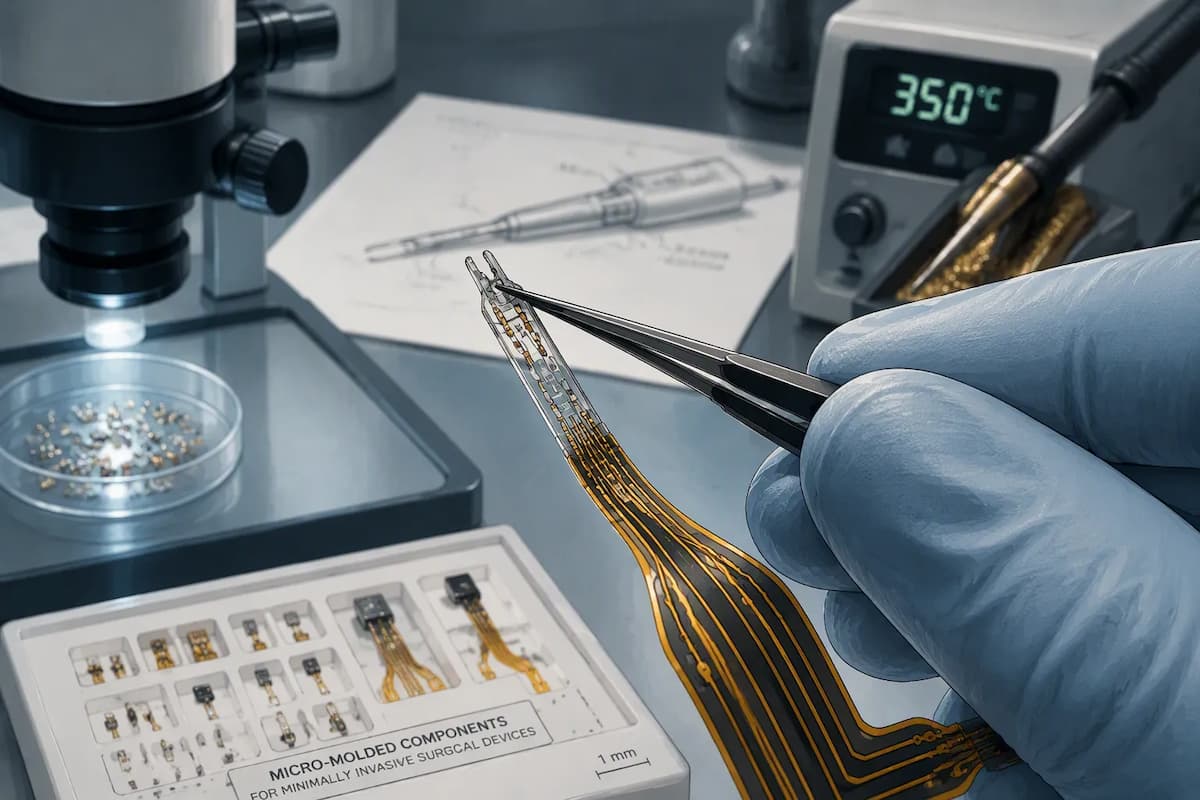
Understanding component-level design principles separates successful devices from those that fail in the field. Component selection in miniaturization, material compatibility, and integration determine whether your medical device performs reliably during invasive procedures. Minimally invasive surgery demands components that meet extreme conditions. Robotic surgery systems amplify these demands.
Miniaturization, Flexibility, and Durability
Limited PCB area forces trade-offs in component placement, thermal dissipation, and trace routing. Flex assemblies solve form factor issues but increase susceptibility to mechanical stress. Medical device manufacturers must balance miniaturization with mechanical reliability when selecting components.
Power management adds constraints. Tight energy budgets require reducing quiescent leakage for standby life, but you must accommodate high peak currents during wireless bursts. Clock selection becomes a power decision as much as a timing one. High component density creates EMC risk. Co-located RF radios, digital control loops, and analog sensing channels produce crosstalk. Filtering components are often required to control interference while working within limited space constraints.
"Miniaturization is a key driver for adding more features and/or allowing for further form-factor reductions. This often translates into better diagnostics, faster recoveries, or overall better patient care." — Aaron Johnson, VP of Customer Strategy at Accumold.
Flexibility and durability must coexist. Invasive devices require components that flex during navigation through curved anatomy, then return to their original shape. Material selection determines whether devices can survive repeated articulation cycles.
Material Compatibility and Sterilization
Medical procedures subject components to demanding sterilization environments. Autoclaving, gamma radiation, and chemical cleaning degrade materials over time. Selected materials must maintain properties through hundreds of cycles. Minimally invasive surgery depends on components that survive repeated sterilization.
Medical-grade materials such as engineered thermoplastics and silicone must maintain mechanical performance, dimensional stability, and biocompatibility throughout repeated sterilization cycles. Material selection plays an important role in component reliability, especially for parts exposed to heat, chemicals, mechanical stress, or biological environments. For medical device manufacturers, choosing materials that meet both performance and regulatory requirements is essential for long-term device reliability.
Integration and Customization Requirements
Custom dimensions drive component design for minimally invasive surgery. Standard off-the-shelf parts rarely fit the tight spaces inside endoscopic instruments. Endoscopic surgery places particular demands on component size and shape. Material selection integrates with component design. The same polymer providing biocompatibility must bond with adjacent materials. Medical applications need seamless integration to prevent failure points.
Component integration reduces assembly complexity. Insert molding and overmolding combine multiple functions into single parts. This eliminates connection points that could fail during invasive use. Minimally invasive surgery devices benefit from reduced component count. OEM and ODM partnerships become essential for complex minimally invasive surgery systems. Successful medical device development requires manufacturing partners who understand component-level challenges. Quality control systems must verify every dimension and material property. Medical instruments require precise manufacturing tolerances at every stage of production.
Custom Manufacturing and Integration Services
From Prototyping to OEM/ODM Production
The journey from concept to finished medical device component requires careful planning. Development typically starts with prototypes that validate design concepts. Prototyping allows medical device manufacturers to validate component dimensions, material choices, and assembly requirements before moving into full-scale production. Early-stage testing helps identify potential design challenges and ensures that components can meet the performance requirements of the final device.
When you move to full-scale production, the approach changes. OEM and ODM partnerships become essential for complex invasive systems. Custom design, material selection, and component integration all matter. The transition from prototype to production demands careful process definition.
Quality Control and Certifications
Quality control is a critical part of medical device component manufacturing, especially when components must meet strict requirements for reliability, consistency, and regulatory compliance. From prototype validation to full-scale production, manufacturers need controlled processes to ensure that every component meets defined specifications.
During production, quality systems focus on dimensional accuracy, material verification, process consistency, and traceability. Comprehensive inspection procedures and documented workflows help identify potential variations and maintain product reliability across production batches.
For medical device manufacturers, choosing a supplier with established quality management systems is essential. Certifications such as ISO 13485 demonstrate a commitment to medical device manufacturing standards and continuous quality improvement.
The success of minimally invasive medical devices depends on components that are small, reliable, and precisely engineered. Reliable connectors preserve signal integrity, flexible tubing supports stable fluid delivery, and advanced materials help devices withstand demanding clinical environments. Effective integration of navigation, imaging, and energy delivery components is essential for next-generation medical device development.
As the field evolves, demand for custom, integrated solutions grows. Miniaturization, material compatibility, and sterilization resistance remain critical. For companies developing new devices or optimizing existing platforms, partnering with a manufacturer who understands these component-level challenges is essential. Contact NISUS to discuss your custom component requirements.
FAQ
What factors affect sterilization resistance of medical device components?
Most invasive instruments endure hundreds of autoclave, gamma, or chemical sterilization cycles. The exact number depends on the selected material. TPU and silicone both resist degradation, but silicone typically maintains flexibility longer. Cycle counts should be verified through accelerated aging tests before clinical use.
What causes signal loss in endoscopic imaging cables?
Signal loss occurs when connectors have inconsistent contact resistance or when impedance mismatches develop. EMI from operating room equipment also corrupts video data. Fiber optic transmission eliminates this interference completely. For 4K systems, medical imaging systems require cables supporting at least 18 Gbps to maintain image quality at 60Hz.
How do I choose between TPU and silicone for catheter tubing?
TPU provides higher tensile strength and kink resistance, making it ideal for pushable catheters. Silicone offers superior flexibility and biocompatibility for long-term implantation. The appropriate choice depends on the specific procedure requirements. Endovascular surgery often requires TPU's pushability, while chronic use favors silicone's softness. Choosing between TPU and silicone depends on the device requirements, application environment, and manufacturing considerations.
What quality certifications should I look for in a manufacturing partner?
ISO 13485 certification demonstrates a manufacturer's commitment to medical device quality systems. Manufacturers should also verify their documentation practices for traceability and inspection procedures. Invasive applications demand tighter tolerances and more rigorous batch monitoring than non-invasive alternatives. Ask for their validation protocols before committing to production.